West Boca Raton encompasses many newer communities on either side of State Road 7/Highway 441. With A-Rated Schools, and newer construction, many families are drawn to the area. Easy access to downtown Boca down major roads. Near Florida Turnpike with access to major airports. Realtor MARILYN JACOBS knows West Boca and can quickly sell your property and/or find you the HOME OF YOUR DREAMS!
Sunday, April 10, 2016
ALL ABOARD FLORIDA'S BRIGHTLINE TRAINS WILL BE PET FRIENDLY, A MOVE TOWARDS PROGRESS
All Aboard Florida's passengers can include pets on their 32 daily trains from Miami to Orlando. Stops include West Palm Beach and Ft. Lauderdale.
The West Palm Beach segment has their launch planned for the end of 2017, but that date may be changed, according to officials.
Wednesday, April 6, 2016
WHAT YOU NEED TO KNOW ABOUT SELLING YOUR PROPERTY RIGHT NOW!
If you live in Florida, you are
really in luck. Real estate prices are rapidly increasing due to the low
inventories and a hot job market - it is a seller’s market. Keep your eye on the following
factors:
1. Why it's a seller's market.
If the economy in a particular region such as Palm Beach County has bounced
back strong since the downturn that began in 2008, home prices will be higher
because more people will be coming to that area for employment or to retire and
relax. Most of Palm Beach County prices have outreached expectations, sometimes
higher than the peak in 2007 and 2008. It may be that prices are or will
be staying more steady in the near future, but they are HIGH now.
2. The price must be right. It
is more important than ever to work with an experienced, licensed Realtor who
understands your local market trends and issues. You will need to price your
home at the going market rate that reflects not only the value of your home but
the neighborhood where it is located. Price too high, and there will be little
interest in your property; too low, and potential buyers may wonder what hidden
issues your property may have. As a Realtor in Palm Beach County since
2000, I have been asked that question many times… “Why is the price so
low? What is wrong?”
3. Going up... or down. Mortgage rates have a
significant effect on the dollar figure that you use to price your home.
As percentage rates go up, you have to subtract the top dollar amount you
had planned to spend to compensate and stick to your budget. While
mortgage rates have been historically low in order to make homes more
affordable, this is a trend that may not continue in the near future so it may
be prudent to buy while interest rates are low.
4. List during peak season. Take
full advantage of the old rules of supply and demand. When the most people are
looking to purchase a home is the best time to put yours on the market. The
summer months especially June, July and August, are one of the hottest times
for buyers who are planning where to be the following winter, or where to
reside when school begins in the late summer and a great opportunity for you to
take advantage of potential bidding wars and faster sales. Fall is a good
time as well, and January, February and March are perhaps the hottest selling
months.
5. Incentives. Yes,
incentives work in a seller's market. Last year more than a third of all
home sellers offered incentives. With a good percentage of the market made up
of first-time home buyers and second home buyers, providing incentives could
result in higher profit and a faster sale for you.
Want
to chat about the status of the market in our area, and what incentives could
help a sale? Connect with me, a luxury homes specialist, today to get
started. Call or text 561-302-3388 or my landline 561-513-6180.
Monday, April 4, 2016
WHY ARE CLASSES ARE SO IMPORTANT IN SCHOOLS
Arts education
paints more than a pretty picture
When schools cut art programs to save money, kids from
low-income families pay the biggest price in lost motivation, lost opportunity,
and lost life skills.
From
GREAT SCHOOLS.
Until recently, 11-year-old Sinai dreamed of playing pro
basketball. Now, he also imagines becoming an artist. What makes this shift so
surprising is that until last year, the dark-haired, serious fifth grader had
never done art. At home he had never finger-painted, colored in a coloring
book, or drawn chalk pictures on the sidewalk. His school had offered no arts
and crafts either – no Play-Doh, painting at an easel, or making collages with
dried macaroni and glitter.
“Before, we didn’t have art and we weren’t creative. Now
I want to come to school,” says Sinai, a sixth grader at Taft Community School
in Redwood City, California.
When Robyn Miller became principal three years ago, Taft
had no art classes. Despite its proximity
to the gated grand estates of Silicon Valley, nearly three-quarters of Taft’s
500 students are eligible for free and reduced price lunch. Like thousands of
schools serving predominantly low-income, African American and Hispanic
children, Taft eliminated the arts to balance shrinking budgets years ago.
If arts education were simply an extra, like a pretty
picture hanging on a classroom bulletin board, then losing it could be written
off as just another regrettable fiscal reality. But recent studies show that arts education
builds a critical cognitive bridge between acquiring knowledge in school and
putting it to use in the real world.
“Art isn’t memorization, it’s a way of thinking, and
creativity is often a significant component,” explains James Catterall, a
retired UCLA education professor and founding director of the Centers for Research
on Creativity. “It encourages asking questions, it encourages taking
some risks, and it encourages collaborative work.”
Having art in school is valuable for all students, but
research suggests it’s especially critical for low-income children whose
parents can’t afford to take them to museums with hands-on art activities or
pay for after-school art classes at the community center. These children are
often deprived when it comes to artistic activities that teach them a different
way of thinking than what they are exposed to in their academic classes.
Miller wanted to restore art at Taft, but the school
didn’t have the money to hire a credentialed art teacher. She found an
affordable alternative in Art in Action, a non-profit organization based
in neighboring Menlo Park, which had been implemented successfully in her
previous district.
Schools pay a $200 licensing fee, about $10 per student
per year, for each class that uses the program, which focuses on visual arts.
For that, they get access to online curriculum with 12 lessons each for
Kindergarten through eighth grade. Thanks to a network of thousands of parent
volunteers who teach art in their children’s schools, the organization keeps
its costs down.
“With this program, we’re getting volunteers who have
been trained (and have) the passion and excitement to bring to the kids each
week,” says Miller. “We’re giving (students) an opportunity to explore
creatively and have their imaginations soar and be innovative, maybe even in
solving problems.”
She says Art in Action supports these connections because
its lessons are aligned with the new Common Core standards in math, reading,
and writing, and can be tailored to fit the curriculum in all other subjects
from history to geography.
Math and the Underground Railroad
“What is four times four?” parent Michele Haussler asks
Sinai’s class at Taft. “Sixteen,” they answer in unison.
She holds up a small square of pink construction paper
and demonstrates how to fold it into four and then into 16 equal squares.
As the students fold their own paper squares, Haussler
tells them about the African American artist Faith Ringgold, now 85-years-old,
who is best known for her quilts depicting stories of race and racism.
Ringgold’s work was influenced by quilts made by slaves in the South that had
coded symbols sewn into them.
The kids are rapt as Haussler describes how slaves would
hang the quilts on fences as if they were drying laundry, but they were
actually signposts guiding runaway slaves to freedom in the North.
The high cost of cutting art
When kids are engaged in high-quality arts education,
“not only is there a difference between how they act during art classes and
lessons, but it seems to spill over to more engagement in school generally,”
says Catterall.
The stats on the importance of arts education confirm
Catterall’s observations. Schools with dynamic art programs have higher
attendance rates, stronger morale, and better test scores than other schools,
according to a 2011 report from the President’s
Committee on the Arts and the Humanities.
Catterall’s 2012 analysis of students at high-income
and low-income schools with and without arts education found that, across the
board, students at schools with strong art programs do better in nearly every
respect.
The benefits are especially significant for poor children
enrolled in arts-rich schools. Twice as many attended four-year colleges or
universities, compared with poor kids at schools without much art. And they
were three times as likely to earn a bachelor’s degree. They were also less
likely to drop out. Perhaps unsurprisingly, low-income students from arts-rich
schools were found to be more engaged overall — more involved in sports, clubs,
and volunteering, and more attuned to current events.
Double-edged sword
When teacher Judy Sleeth founded Art in Action in her
child’s school district in 1982, arts education had been decimated in
California by Proposition 13, the 1978 ballot measure that
led public schools to lose billions in funding almost overnight. Today, Art in
Action reaches about 50,000 students in more than 200 schools in 19 states,
from California to Florida. Over the next three to five years, the program
plans to nearly double the number of students it serves. But not all agree that
organizations like Art in Action are the best way to get arts education into
schools.
“We would never want to see an outside arts or culture
organization replace an arts teacher,” says Doug Israel, director of research
and policy at the Center for Arts Education, which advocates for
professional art teachers in every New York City Public School. Ultimately,
however, Israel says Art in Action and similar programs are “a benefit for
students and better than no arts.”
Teachers are keenly aware of those benefits. At Taft,
fifth grade teacher Jessica Kwa says she’s already planning to use the Faith
Ringgold lesson when they start working on fractions.
“It’s definitely easier for them to have something to
refer back to,” says Kwa.
Art also has something of a transcendent effect on her
students, some more than others. She recalls a boy named Joel who missed
homework and disrupted class. Art in Action changed him.
“I was surprised because I hadn’t seen him so meticulous
with any work before,” says Kwa. “I immediately jumped on that opportunity to
praise him, recognizing his strengths.”
When he got stuck on concepts in math and started to give
up, she would refer to art class to remind him of his capabilities. Over time,
Joel made those connections instinctively. He became more focused in class,
turned in his homework on time, and his grades improved.
Friday, April 1, 2016
WHAT IS JEFF GREENE, BILLIONAIRE REAL ESTATE INVESTOR, DOING NOW?
No doubt you know that
he has purchased many West Palm Beach properties for about $300MM, plans to
build many new condo developments, and is West Palm Beach’s biggest booster for
additional condo units at all prices and sizes.
One or another will appeal to you!
Thinking of movin on up? Be a
little patient!
He recently said,
speaking at the Urban Land Institute in West Palm Beach, that his priority is
One West Palm at 550 North Quadrille Boulevard.
Arquitectonica of Miami has designed the $250MM project which will take
an entire block. Two 30-floor towers are
planned which resemble stacked blocks, an interesting new and contemporary look
for West Palm Beach. We are moving right
along into the 21st century.
Get your buys and
reservations in line soon and watch for when you can do that! You will enjoy the forthcoming shops, restaurants,
corner parks, a daycare center and fitness center with indoor and outdoor
tennis courts on the ground floor. One
tower will include 340,000 sq ft of Class A office space and the other will
house a five-star hotel with 209 guest suites and 84 luxury condo or rental
units above that. Ground breaking is
hoped for in the summer or fall. His own
equity and a bank loan will finance this deal. Jeff says, “I am lucky that I do
not have to pre-lease.
In the historic
Northwood area, north of downtown, he owns 5 acres that will become a grocery
store center. Major suspect is Publix.
His plan is to have the grocery store lead to the integration of the
neighborhood. Possible: an
independent/assisted living facility; a fantastic gym.
He is putting up five high-end
condo buildings at once and has submitted a plan for a 12-story 400-unit
micro-apartment building at 550 Banyan Boulevard to city officials. Jeff says,
“West Palm Beach’s economy is driven by tourism and retirees.” The Norton Museum of Art renovation and
construction of a new spring training baseball Astros and Nationals stadium
will, “Make the city better and more people will come.”
Stay tuned.
Monday, February 29, 2016
HERE'S YOUR CHANCE TO SEE RAIDERS OF THE LOST ARK AGAIN!
THE FESTIVAL OF THE ARTS IN BOCA kicks off on March 4th by showing Spielberg's "Raiders of the Lost Ark with the ageless Harrison Ford. The Henry Mancini Institute Orchestra from the U of Miami Frost School of Music will appear live, playing the score at the Mizner Park Amphitheater.
- The Festival runs to March 16th and includes
- Performances of Mozart's Magic Flute and Vivaldi's Four seasons
- Herb Alpert in concert and Lani Hall
- Performance of Cirque de la Symphonie
For more information go to http://festivaloftheartsboca.org/ .
Thursday, February 25, 2016
CULTURAL EVENTS, TONS OF SHOPPING FROM EXPENSIVE TO CHEAP, ART & ANTIQUES, HISTORIC HOMES, ELITE RESTAURANTS TO DINERS, WATERFRONT (ICW) VIEWS, MUSEUMS, BIG BOATS GALORE, SYMPHONIES & SHOWS, BEST BROWSING MOST ANYWHERE… NEAR POLO PONY GAMES, NEAR WORTH AVENUE… Something for everyone!
March 5th… mark your calendar and save the date for the annual Antique Row chic street party with entertainment, food and shopping.
Browse to find that one exquisite 17th, 18th, 19th or 20th C. antique, decorative art piece, vintage or moderne furnishing, lighting and accessory, deco, work of art and much more.
From 6 to 9 pm, head over to Southern Blvd east (I-95 exit 68), left on South Dixie north) and you are there! Browse and buy from over 40 interesting high quality antique stores, specialty shoppes, antique galleries and dine in award-winning restaurants.
Antique Row is heralded by Architectural Digest, The New York Times, Art and Antiques and House Beautiful as one of the east coast’s premier antique shopping districts. Conde Nast Traveler chose Antique Row as 4th best shopping in the US. You will be alongside decorators, avid collectors, antique dealers
Look thru the Directory, reserve for a fine dinner, breakfast or lunch.
Come and join one of West Palm Beach’s premier evening events. See you there!
Monday, February 22, 2016
CONTINUING OUR SERIES ON LOCAL GROWTH, NEW RESIDENTIAL UNITS IN BOCA RATON WILL GROW DOWNTOWN BOCA
Current construction crews are working on:
MARK AT CITYSCAPE, a 12-story building with 208 rental apartments at 11 Plaza Real South near intersection of Palmetto Park Road and Federal Highway – scheduled to be completed in March 2016
VIA MIZNER, also 12-stories with 366 rental apartments, at the corner of Camino Real and Federal Highway; about 1MM sq ft of building reaching 140’ is planned for the rest of the nearly 7 acres. Designated for open space is about 40% of the area.
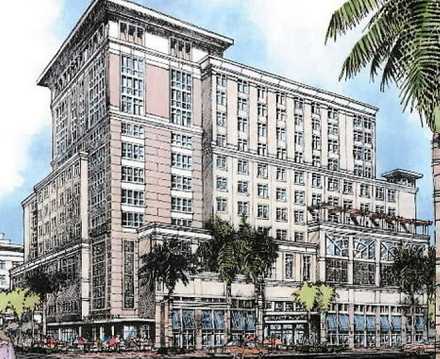
MANDARIN ORIENTAL HOTEL (pictured above to the right) next to Via Mizner will have 164 rooms and 100 condominiums and retail space will be built with connecting adjoining towers
PALMETTO PROMENADE, 9-stories with 378 units, from Northeast 3rd Street and Palmetto Park Road extending east for 900’, it’s façade gives the appearance of multiple buildings but it is just one structure
THE BOCA LOFTS, 7-stories with 229 rental apartments at 33 SE 8th Street
TOWER 155, 12-stories with 170 condominiums, in the 100 block of East Boca Raton Road
HYATT PLACE HOTEL, 12-stories with 200 rooms, at Palmetto Park Road and Federal Highway, expected to open in the summer of 2016, will include an 8000 sq ft restaurant, 4000 sq ft of meeting space, and retail space
When Town Center opened, it drew business from downtown Boca Raton, and downtown businesses suffered. In 2008, the temporary guidelines adopted allowed 12-story buildings whereas previously they were limited to 9 or 10 stories. Mention was made of a more varied, more graceful skyline. The new heights encouraged developers to do more than build a cheaper, boxier version of a building, and the new guidelines call for buildings to be farther back from the street opening a light corridor without a canyon effect.
Better views command higher rents and condominium prices. Downtown will become more vibrant after regular work hours with downtown residents heading to restaurants, spas, boutiques and businesses in the area.
Saturday, February 20, 2016
STAY TUNED FOR MORE INFORMATION ON NEW CONDO DEVELOPMENTS IN PALM BEACH COUNTY
Everywhere we look in Palm Beach County from Boca Raton
to the county’s northern outer reach areas, there is new development going on
bringing new jobs, new businesses, and sooner or later, new residents. That says a lot about the improvement in our
economy when billionaires and millionaires are “putting their monies where
their mouth is.”
Minto Communities is planning a big family-oriented development
with a 6 square mile footprint that they have named Westlake, which they say
will have an economic impact of $1BB (Yes, BILLION) over the next 20
years. The property is on Seminole Pratt
Whitey Road in The Acreage. To compare,
they say it will be slightly larger than the city of Lake Worth. Plans include 4546 single family and town homes
(which may generate $34MM in property tax revenue), 2.1 MM sq ft of commercial
development, a 3,000-student university and a 150-unit hotel. This all will be built on 3800 acres north of
Okeechobee Boulevard.
Impact revenue fee revenues will be generated by Westlake
amounting to $58.7MM, with about $42MM for roads and $7.5MM for schools. Environmental considerations include natural areas and open spaces will occupy over 55% of
the property with over 240 acres of parks, 600 acres of lakes and 15 miles of
walking and biking trails. A Town Center
will be the social hub.
Those in favor say it is orderly planned grow that will
proved a needed economic boost to the area.
The nay-sayers describe it as a traffic-choking idea. Good for you, Minto, to plan to widen about
two miles of Seminole Pratt Whitney Road which will cost them $12MM over the
next 18 months. Some say that people
moved to the area to enjoy a rural lifestyle, but sooner or later this and
other projects will make the area busy and overcrowded. Total build out time is estimated to be a
decade. With ground breaking estimated
to start in 90 days, residential sales may begin in early 2017.
There is, naturally, both concern and happiness about a
forthcoming GL homes community, the
Indian Trails Grove project, where 4,000 homes are planned be built on a
3,900-acre tract not far from Westlake.
With over 1000 people a
day coming to visit Florida, many of whom will want to move to Palm Beach
County, we need to respect and accept progress.
Expansion and new homes and businesses must go west and north to find
tracts of land to build on.
Thursday, February 18, 2016
''BUILD IT AND THEY WILL COME," especially to Paradise!
LAKE WORTH’S HISTORIC GULFSTREAM HOTEL PROJECT APPROVED
Hudson Holdings can now proceed with their $60MM restoration plan.
Built in the 1920’s, the revival is expected to bring more tourism to the area. Located near the west end of the Lake Worth Bridge, with walkable shoppes, art galleries, restaurants and antique shops to browse, it may become a mecca for out of towners. The intracoastal waterway “is right there,” with benches to relax on while watching the boats go by, and the municipal golf course is along the ICW. Plans include an 87-room hotel with a downstairs restaurant, and a 2-story parking garage with at least 145 spaces. Also planned are a champagne room and a rooftop skybar.
The restoration will create 300 jobs and is projected to be finished in 15 months.
Note that in Delray Beach and West Palm Beach investors and developers have plans to update and upgrade those areas with new residential complexes, and new residential buildings have gone up in Boca Raton, and some are in mid-construction. While these plans bring new jobs, they can also bring congestion to these areas, so these objections are being considered too. About 1000 people a day move to Florida, and perhaps in a few years, with the new construction in Palm Beach county, more will come.
This historic property, with its new look, will be a mecca for those looking to buy in the area, a great stopping-off place.
Thursday, February 4, 2016
THIS MEDAL OF HONOR RECIPIENT IS 82. YOU WILL BE STUNNED BY WHAT HE DID IN VIETNAM
This article was originally published on Yellow Hammer News and is written by Cliff Sims .
Bennie Adkins turned 82 on Feb. 1. Exactly 50 years ago, Mr. Adkins was in the jungles of Vietnam. He returned to the United States a legend among Army Rangers, and almost a half-century later was awarded the Medal of Honor for personal acts of valor above and beyond the call of duty during the Vietnam War.
So numerous and heroic were Adkins’ battlefield exploits that President Obama started his remarks at the White House Medal of Honor ceremony by saying that there was no way there would be enough time to describe them all. At another point he paused to simply say, “you can’t make this stuff up.”
Here’s a lightly edited transcript of the official citation, which details a portion of Adkins’ incredible story:
When Adkins’ camp was attacked by a large North Vietnamese and Viet Cong force in the early morning hours of March 9, 1966, Sergeant First Class Adkins rushed through intense enemy fire and manned a mortar position continually adjusting fire for the camp, despite incurring wounds as the mortar pit received several direct hits from enemy mortars.
Upon learning that several soldiers were wounded near the center of camp, he temporarily turned the mortar over to another soldier, ran through exploding mortar rounds and dragged several comrades to safety. As the hostile fire subsided, Adkins exposed himself to sporadic sniper fire while carrying his wounded comrades to the camp dispensary.
When Adkins and his group of defenders came under heavy small arms fire from members of the Civilian Irregular Defense Group that had defected to fight with the North Vietnamese, he maneuvered outside the camp to evacuate a seriously wounded American and draw fire all the while successfully covering the rescue.
When a resupply air drop landed outside of the camp perimeter, Adkins, again, moved outside of the camp walls to retrieve the much needed supplies.
During the early morning hours of March 10, 1966, enemy forces launched their main attack and within two hours, Adkins was the only man firing a mortar weapon. When all mortar rounds were expended, Adkins began placing effective recoilless rifle fire upon enemy positions. Despite receiving additional wounds from enemy rounds exploding on his position, Adkins fought off intense waves of attacking Viet Cong.
Adkins eliminated numerous insurgents with small arms fire after withdrawing to a communications bunker with several soldiers. Running extremely low on ammunition, he returned to the mortar pit, gathered vital ammunition and ran through intense fire back to the bunker. After being ordered to evacuate the camp, Adkins and a small group of soldiers destroyed all signal equipment and classified documents, dug their way out of the rear of the bunker, and fought their way out of the camp.
While carrying a wounded soldier to the extraction point he learned that the last helicopter had already departed. Adkins led the group while evading the enemy until they were rescued by helicopter on March 12, 1966.
During the thirty-eight hour battle and forty-eight hours of escape and evasion, fighting with mortars, machine guns, recoilless rifles, small arms, and hand grenades, it was estimated that Adkins killed between 135 and 175 of the enemy while sustaining eighteen different wounds to his body.
When that last line was read aloud, there was a collective, audible gasp throughout the assembled crowd of friends, family, press and members of the military in the East Room of the White House.
Every member of Adkins’ unit was either killed or wounded during the 48-hour ordeal detailed above. Two of the men he saved were able to attend the event. After the ceremony, Adkins’ thoughts quickly turned to the other heroes with whom he served.
“This Medal of Honor belongs to the other 16 Special Forces soldiers with me,” he said.
President Barack Obama awards the Medal of Honor to Army Command Sergeant Major Bennie G. Adkins in a ceremony at the White House Sept. 15, 2014 (Photo: Cliff Sims)
Medal of Honor recommendations usually must be made within two years of the act of heroism and must be presented within three years. Adkins received his some 48 years after the fact.
So why did it take so long for Adkins to be recognized?
“In 2009, Command Sergeant Major Adkins’ family contacted my office and told us that they were going to try to get this wrong righted,” U.S. Rep. Mike Rogers, Adkins’ congressman, told Yellowhammer.
From that moment forward, Rogers made it his personal mission to make sure Adkins received the honor he was due.
Rogers immediately moved for there to be a review of Adkins’ records. Fortunately, all of the documentation the Army compiled after Adkins’ heroic efforts — including first-hand accounts from American soldiers who are still alive — had been preserved by the Pentagon.
According to the documentation, Adkins was nominated for the Medal of Honor shortly after the battle by his chain of command. In doing that, his commanding officer, who was in the battle with him, wrote a five-page narrative detailing what had happened. The Army then took statements from every soldier who was with him and documented all of the communications that took place during the battle.
But as the recommendation worked its way up the chain of command to the general officer level, they inexplicably decided Adkins’ actions merited the Distinguished Service Cross, the nation’s second highest military honor, rather than the Medal of Honor.
When Congressman Rogers’ office started pushing for the Army to revisit Adkins’ story, there was a treasure trove of original battlefield information still intact.
Command Sgt. Maj. Bennie G. Adkins participating in a press conference just after receiving the Medal of Honor at the White House, Sept. 15, 2014. (Photo: Staff Sgt. Bernardo Fuller)
“You’ve got to get the documentation that supports the review,” Rogers said, explaining the process. “Then the Secretary of Defense has to review it and decide that he would like to see it recommended to the president. After that happened, we had to go back and get an exception to the law, which says that the Medal of Honor must be awarded within three years of the event. So we had to get Congress to pass a law to say this deserves an exception.”
Rogers lobbied his colleagues incessantly.
“There was a lot of resistance, surprisingly,” he said. “But one thing that really helped was that Secretary (of Defense) Hagel was asking for this. He had reviewed it and felt like it was an injustice that needed to be remedied. It finally got passed, but it took several months.”
In addition to lobbying Congress, Rogers also had to make his case to the White House, who would not normally be receptive to the requests of a Republican congressman from Alabama.
“We spent several months pestering the president’s office,” Rogers laughed. “Fortunately they did the right thing.”
“Sometimes even the most extraordinary stories can get lost in the fog of war or the passage of time,” President Obama said. “When new evidence comes to light, certain actions can be reconsidered for this honor, and it is entirely right and proper that we have done so.”
As for the reason why Adkins and other deserving soldiers were not properly honored initially upon their return, Rogers said he was not exactly sure, but believes it could have been a combination of the post-war political climate, as well as prejudice.
“There were clearly some prejudices involved when you look at who was and wasn’t recognized after Vietnam,” he said. “Some folks were of a different race, some folks were a certain religion, and some folks were from the South. So there was some of that involved. It may have been because Bennie was a southern boy. You never know.”
In late September of 2014, all of the efforts of Adkins’ family and Rogers’ office came to fruition. Four of the five living men whose lives were saved by Adkins between March 9 and March 12, 1966 joined him at the White House in a scene that had been a half-century in the making.
Adkins, who usually walks with a cane, rose unassisted and stood at attention as the President of the United States bestowed upon him his nation’s highest military honor. Adkins’ chin quivered ever so slightly as President Obama placed the medal around his neck. His wife of 60 years, Mary, beamed with pride on the front row, smiling as she wiped tears from her eyes.
Adkins snapped off a perfectly formed salute to the crowd before exiting the stage.
“This Medal of Honor belongs to the other 16 Special Forces soldiers with me,” he would later say with genuine humility.
And as the Army Chaplain led the audience in a closing prayer, Bennie G. Adkins of Opelika, Ala., stood once more to honor the One who had always been with him, from the jungles of Vietnam to the East Room of the White House and everywhere in between.
Subscribe to:
Posts (Atom)